
SPID Label Forensics: Decoding Classic Chevrolet C10 Factory Options
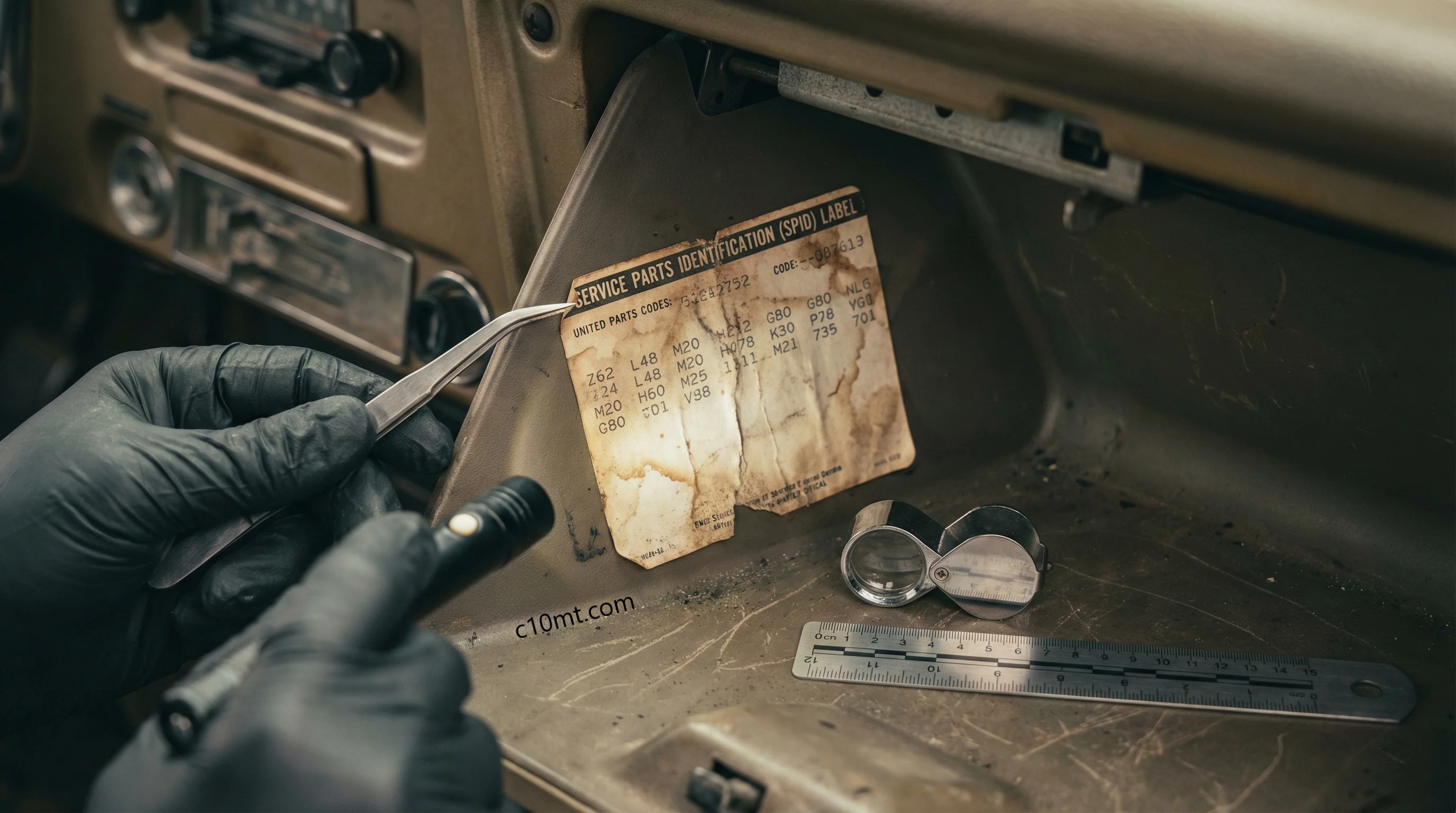
The primary objective of this report is to establish a rigorous, forensic methodology for the authentication and verification of Classic Chevrolet C10 pickup trucks (specifically model years 1967–1987) through the analysis of the Service Parts Identification (SPID) label. This academic rigor has become an essential safeguard in a landscape where the "Action Line" (1967–1972) and "Square Body" (1973–1987) generations have seen valuations rise exponentially.
As these prices climb, the economic incentive for the fraudulent misrepresentation of base-model vehicles as high-trim specifications—such as the Cheyenne Super, Silverado, or Big Block configurations—has increased proportionately. To counter this, the collector must look beyond the surface to the SPID label: a fragile paper document typically adhered to the glovebox door or inner fender that serves as the vehicle's "genetic code."
By listing the specific Regular Production Options (RPOs) installed at the factory, the SPID label provides the granular detail necessary to distinguish a genuine factory high-performance build from a posthumously assembled "clone"—a level of specificity that the broader Vehicle Identification Number (VIN) simply cannot offer. Consequently, mastering this document is the cornerstone of the forensic verification workflow presented here.
This report aims to equip restorers, collectors, appraisers, and automotive historians with the technical knowledge to locate and preserve the SPID label using conservation-grade techniques, decode alphanumeric RPO codes to reconstruct original configurations, and authenticate the label itself by analyzing typography and paper stock against factory standards. By cross-verifying this data against VINs, cowl tags, and casting numbers, the ultimate goal is to produce a verifiable "Certificate of Configuration" that confirms a vehicle's true provenance, distinguishing genuine survivors from fraudulent forgeries.
The urgency of this verification is underscored by the radical transformation of the classic truck market over the last decade. What was once a segment defined by utilitarian value has evolved into a high-stakes investment class, with pristine 1972 Cheyenne Supers or 1987 Silverado R10s frequently exceeding six figures at auction. In such a high-stakes environment, the difference between a verified, "numbers-matching" factory build and a base-model "clone" can represent a valuation delta of $50,000 or more.
This massive price disparity unfortunately creates a fertile ground for fraud, where unscrupulous sellers may swap VIN plates, forge engine stamps, or apply reproduction SPID labels to suggest a false pedigree. For the modern market participant, the ability to forensically analyze the physical medium of the label and cross-reference its data is no longer merely an academic exercise; it is a financial necessity.
Navigating this financial reality requires an understanding of the inherent "core tension" between preservation and restoration. The SPID label is an ephemeral document never intended by General Motors to last fifty years; printed on inexpensive paper with impact printers and mass-production glues, these labels are naturally prone to desiccation, fading, and disintegration.
Because of this fragility, the methodology proposed herein prioritizes conservation—arresting further degradation—over invasive restoration techniques that can destroy an artifact's forensic utility. We operate under the firm principle that a damaged, illegible original label holds significantly more forensic weight than a pristine reproduction, provided the remaining fragments can be scientifically analyzed and contextualized within the vehicle's broader physical evidence.
1. Background
To understand the SPID label, one must first understand the industrial and historical context of General Motors' truck production during the target era. The evolution of the SPID label mirrors the broader evolution of the C10 from a farm implement to a lifestyle vehicle, and the concurrent rise of computerized assembly line management.
1.1. The "Action Line" Era (1967–1972)
The 1967–1972 C/K series, colloquially known as the "Action Line," represented a paradigm shift where trucks began to transition from purely utilitarian workhorses to comfortable personal vehicles. This era introduced high-end trim levels like the CST (Custom Sport Truck) and later, in 1971, the Cheyenne and Cheyenne Super. These trucks featured carpeting, bucket seats, air conditioning, and extensive brightwork—options that had previously been the domain of passenger cars like the Impala.
As the option list grew, so did the complexity of the assembly process. A worker on the line at the St. Louis or Flint plant needed a reliable way to know exactly which alternator, spring rate, or interior trim panel to install. The VIN was insufficient for this task; a VIN might indicate a V8 engine, but it would not specify whether that engine required a heavy-duty cooling radiator or a standard one. The SPID label was the solution: a manifest attached to the vehicle itself, bridging the gap between the factory build sheet (often lost) and the service technician.
During this era, the SPID label was almost exclusively located on the inside of the glovebox door. The physical label was typically a rectangular paper sticker with blue horizontal lines, printed using impact line printers or, in lower-volume scenarios, typewriters. This printing technology imparted specific physical characteristics—such as ink indentation and ribbon weave patterns—that are crucial for forensic authentication.
1.2. The "Square Body" Era (1973–1987)
The 1973 redesign, officially the "Rounded Line" but universally known as the "Square Body," brought further modernization. As computerization of the assembly line advanced, the SPID label evolved. While initially similar to previous iterations, the format and location experienced transitions. By the mid-1980s, specifically around the 1984–1986 transition, GM began standardizing the RPO codes into the strictly three-character alphanumeric format that persists today.
The location of the SPID also became more variable during the later years of the Square Body run. While the glovebox door remained the primary location, transitional models and specific assembly plants occasionally placed the label on the inner fender well or the underside of the hood. This era also saw the transition from purely paper-based labels to slightly more durable substrates in later years, leading up to the eventual adoption of laser-printed labels and, decades later, QR codes.
1.3. The Technological Context: Impact Printing
A critical background element for the forensic examiner is the nature of the printing technology used. From 1967 through the mid-1980s, the dominant technology for generating these labels was the impact dot matrix printer or line printer. These machines worked by striking an ink-soaked ribbon against the paper.
This mechanical action has two forensic implications:
- Indentation: Genuine labels often show microscopic indentation where the character was struck. Modern laser or inkjet reproductions lie flat on the surface of the paper.
- Ink Chemistry: The ink used in vintage ribbons differs chemically from modern toner. It is often soluble in different solvents than modern inks, a fact that dictates our preservation protocols.
Understanding this technological lineage is essential for distinguishing a genuine artifact from a modern forgery created with high-resolution scanning and laser printing.
2. Data Sources
The validity of any forensic analysis rests on the quality of its reference data. For the Chevrolet C10, relying on internet forums or anecdotal evidence is insufficient for high-level verification. This report synthesizes data from a hierarchy of authoritative sources.
2.1. Primary Factory Documentation
The gold standard for verification is the documentation generated by General Motors itself.
- GM Heritage Center: The archives provide vehicle information kits that include the original option lists, sales brochures, and AMA (Automobile Manufacturers Association) specifications for each model year.
- Factory Assembly Manuals (FAM): These engineering documents were used on the assembly line to instruct workers on how to assemble the vehicle. They contain the specific RPO codes required to trigger the installation of certain parts (e.g., "RPO Z84: Install Trim Panel A"). The FAM is the ultimate arbiter of which parts belong to which RPO code.
- Dealer Data Books: These books were used by salesmen to order trucks. They list option restrictions and requirements (e.g., "RPO C60 Air Conditioning requires V8 engine"). These rules are critical for identifying "impossible" combinations in forged SPID labels.
2.2. Forensic Artifacts
This report draws on the analysis of high-resolution imagery of verified original SPID labels. By examining survivors, we establish a baseline for:
- Paper Grain and Oxidation: How the paper yellows over 50 years.
- Adhesive Aging: The specific "mapping" or staining patterns caused by the breakdown of the factory glue.
- Typography: The specific font faces and character spacing used by different assembly plants (e.g., Fremont vs. St. Louis).
2.3. Technical Manuals and Catalogs
Aftermarket support for the C10 is robust. While reproduction parts catalogs (LMC Truck, CJ Pony Parts, Classic Industries) are secondary sources, they are valuable for mapping RPO codes to modern part numbers and visual identification. However, one must be cautious, as catalogs often consolidate parts (e.g., selling a 1972 grille for a 1971 truck), whereas forensic verification requires distinguishing the specific year-correct part.
2.4. Expert Consensus and Databases
We integrate insights from established marque specialists and digital databases like 67-72chevytrucks.com and GloveBoxOptions.com. These communities have aggregated vast amounts of data regarding "outlier" trucks—vehicles that deviate from the norm due to special orders or mid-year production changes.
Technical Inspection & Safety Notice: This guide serves as a forensic framework for provenance verification and RPO-based authentication only. While authenticating factory build codes is essential for investment protection, it does not constitute a mechanical safety clearance. Given the age of these classic trucks, all safety-critical systems - including chassis structural integrity, steering kinematics, fuel system sealing, and hydraulic brake performance - must be inspected and cleared by a certified technician before operation. Compliance with local emissions and safety standards remains the sole responsibility of the owner.
- Used 1972 Chevrolet C10 Pickup 1/2 Ton Fleetside LWB Options - J.D. Power
- Identification of a Clone: How to Pick Out a 1971 Chevy Truck from a '72 - MyStarCollectorCar
- Chevy Truck SPID Labels - Classic Chevy Trucks
- Preserving Paper Stickers Long Term - Arts & Crafts Stack Exchange
- 1967–1972 Chevrolet C/K Base: 2nd-Gen Specs & Guide - MotoGallery
- Chevrolet C/K (Second Generation) History - Wikipedia
- GM RPO & SPID Sticker Guide for Engines & Transmissions - Houston Engines
- Where to Find GM RPO Codes: Older SPID vs New QR Labels
- Custom Made Impact Printer SPID Labels - GloveBoxOptions
- 1978 Chevy Technical Discussion - Classic Parts Talk
- GM RPO Codes VIN Decoder - Chevrolet, Buick, Cadillac
- History of the Dot Matrix Printer in Automotive Labeling - OmniData
- Risk Assessment: Isopropyl Alcohol Damage on Paper Labels - Reddit Case Study
- GM Master Option Code List - Full PDF Reference
- 1972 Chevrolet Truck Heritage Archive Data - GM News
- 1967-72 Chevrolet Truck Chassis Identification - LMC Truck
- Chevy/GM RPO Codes from 1967-1986 - CJ Pony Parts
- 1960-1972 Chevy Truck Model Years Identification Guide - Classic Industries
- History of 1967-1972 GM Pickup VIN and Model Formats
- 1967-1972 GM Pickup Reproduction SPID and Window Stickers
- Reviving Old Impact Printer Cartridges - BCH Technologies
- Removing Labels with Rubbing Alcohol vs Acetone - Laboratory Test
- Conservation Services: Surface Cleaning of Historical Documents - Missouri SOS
- 7.2 Surface Cleaning of Paper - Northeast Document Conservation Center (NEDCC)
- Solvents for Letterpress and Impact Printing - Briar Press Community
- Service Parts Glove Box ID Decal (1967-72) - HH Classic
- GM Body Tag Decoding - Drivin' It Home
- SPID Label Paint Code Popularity Rank - Data Analytics
- How to Identify GM Transmissions (TH350, TH400, etc.) - Speedway Motors
- Typography Identification for Vintage GM Labels - Graphic Design Stack Exchange