
Decoding the Chevy C10 VIN: Identifying Factory Build Codes
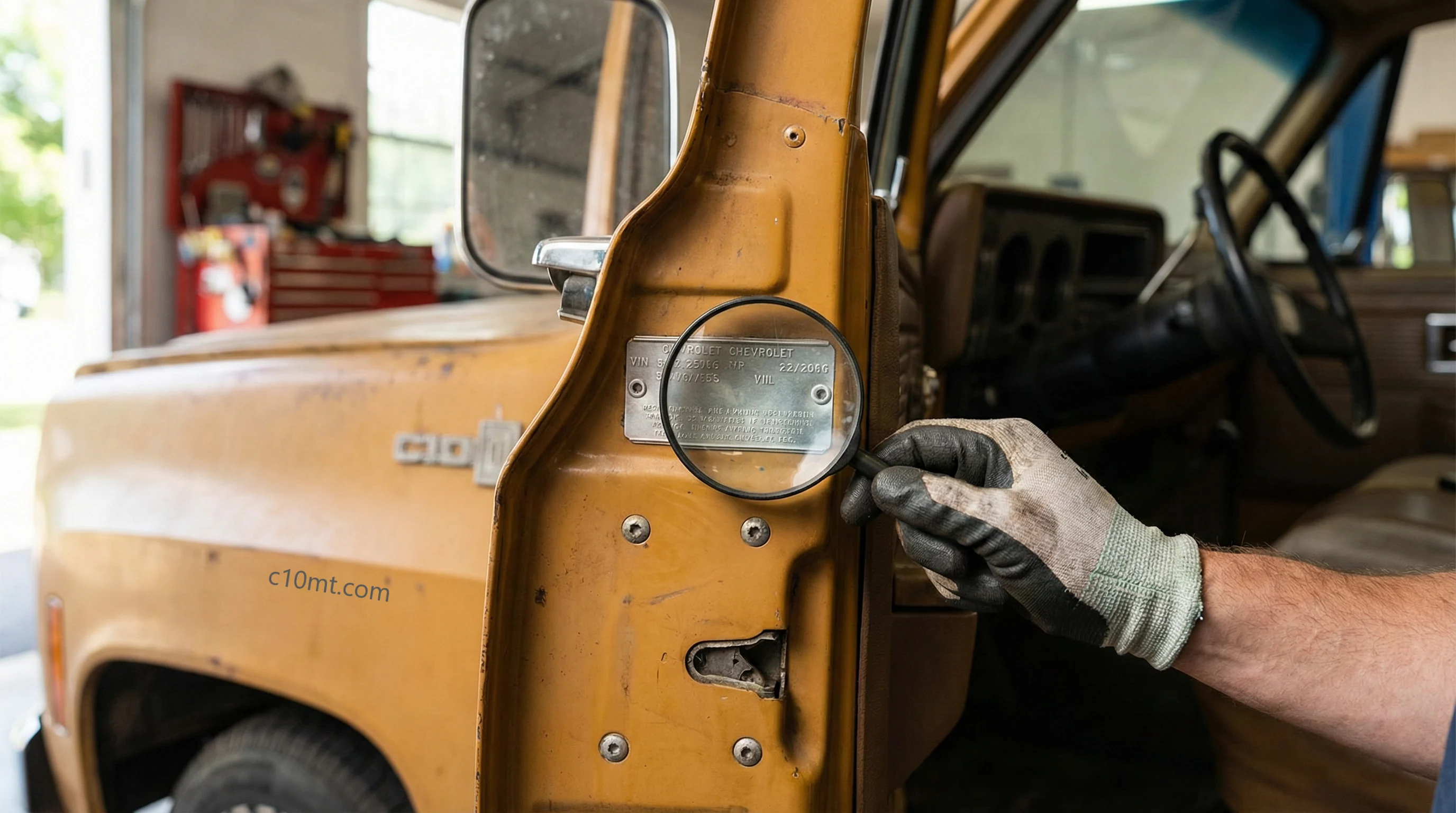
Verifying a classic Chevrolet C10 is a forensic exercise in automotive history: the vehicle's true identity is encoded in a layered set of artifacts—its Vehicle Identification Number (VIN), factory plates and tags, confidential frame stamps, and the subtle manufacturing signatures found in fasteners, typography, and assembly marks. This guide provides an exhaustive, expert-level methodology for decoding those artifacts across three critical Chevrolet truck eras: the First Generation (1960–1966), the Action Line (1967–1972), and the Squarebody (1973–1987).
Why this matters: VIN fields and secondary identifiers are not merely catalog numbers; they are cross‑referenced signals that, when read together, confirm factory build, options, and assembly provenance. A single VIN field can indicate model year or plant, but only corroboration with cowl tags, trim codes, and frame stamps converts that indication into verification. Conversely, mismatches—typographic anomalies, non‑period fasteners, or absent confidential stamps—are red flags that require deeper forensic inspection.
What this guide delivers: a step‑by‑step verification workflow; era‑specific VIN syntax and field maps; the forensic characteristics of factory fasteners and stamping typography; the most reliable locations for confidential frame stamps; and annotated case studies showing how to resolve common conflicts between documentation and physical evidence. Each section pairs technical explanation with concrete actions—what to photograph, which measurements to record, how to interpret discrepancies, and where to seek archival factory records—so you can move from observation to confident conclusion without guesswork.
Read this guide as both a reference and a procedure: consult the primer to understand the syntax, use the forensic markers section while inspecting the truck, and follow the verification workflow to reach a defensible conclusion. The case studies demonstrate how the same evidence patterns recur across different trucks and how to interpret ambiguous signals without overreaching.
1. The Philosophy of Automotive Archaeology: VIN as Manufacturing DNA
Imagine standing before a weathered 1970 Chevrolet C10. To the casual observer, it is a collection of patina, chrome, and rubber. But to the automotive archaeologist, this truck is a singular, cohesive organism—a "snapshot in time" captured at the exact moment it rolled off a General Motors assembly line. The concept of "Matching Numbers" or "Factory Originality" is more than just a collector's buzzword; it is the fundamental premise that a vehicle possesses a unique identity, defined by its manufacturing DNA.
At the heart of this identity lies the Vehicle Identification Number (VIN). However, a seasoned investigator knows that the VIN is merely the primary key in a much larger, encrypted database. To truly verify a truck's soul, one must look beyond the dashboard. In the high-stakes world of classic Chevrolet restoration, the truth is found in the "triangulation" of data points—a complex web that connects the VIN to the cowl tag on the firewall, the Service Parts Identification (SPID) label in the glovebox, and the silent, stamped "confidential" codes hidden deep within the steel frame rails.
The journey through this manufacturing history is one of evolution. Between 1960 and 1987, General Motors operated within a rapidly changing landscape of industrial tracking and federal oversight. In the early 1960s, identification systems were rudimentary, designed for the internal logistics of the factory floor. But as the 1970s arrived, bringing with them a surge in automotive theft and the tightening of federal regulations, the complexity of these identifiers increased exponentially. This evolution culminated in the pivotal 1981 mandate by the National Highway Traffic Safety Administration (NHTSA), which established the standardized 17-digit VIN system used globally today (49 CFR Part 565).
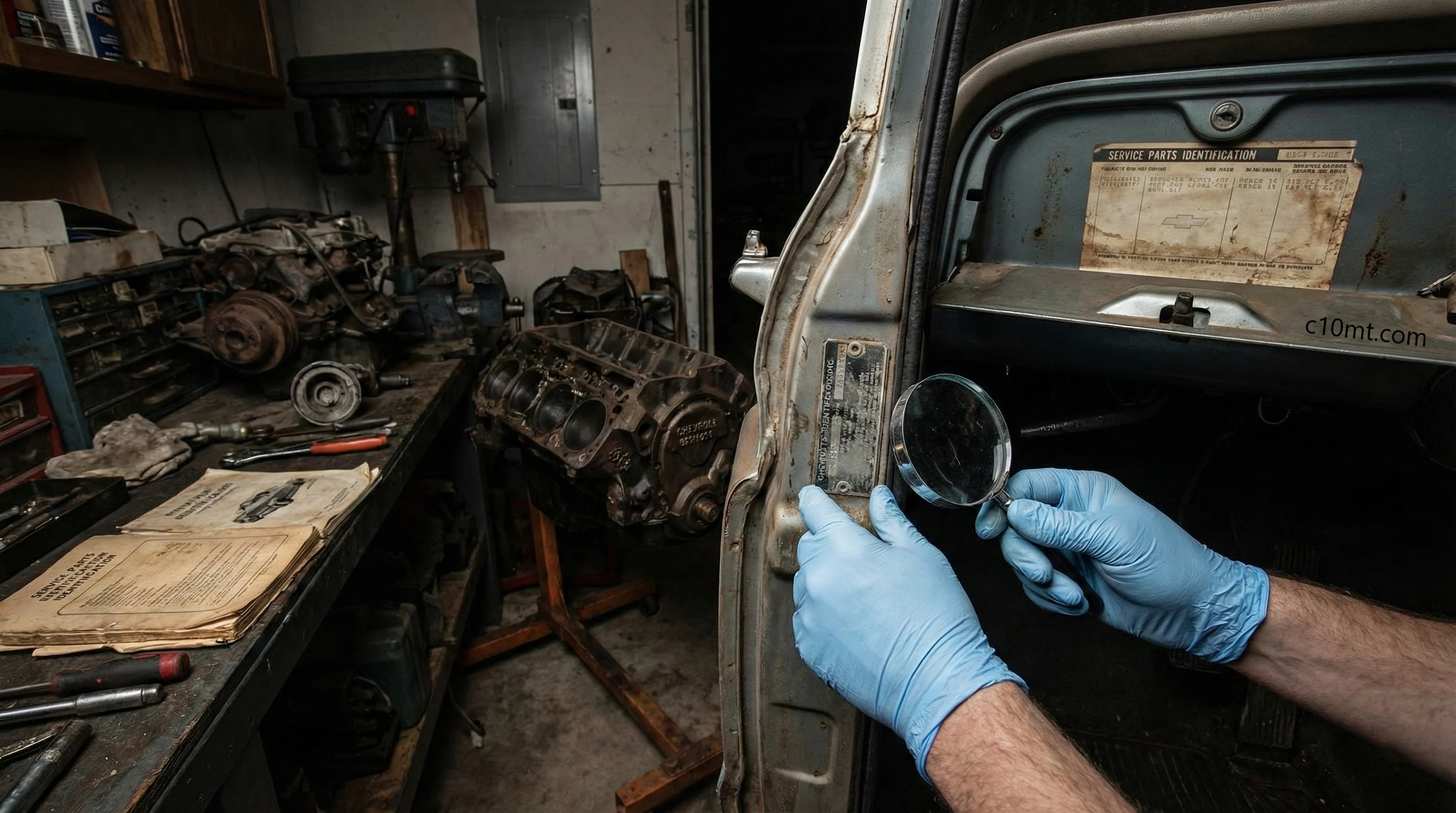
For the investigator, understanding this timeline is the difference between a sound investment and a costly mistake. For instance, a VIN format that is historically appropriate for a 1964 production line would serve as an immediate "red flag" if discovered on a truck claiming to be a 1972 model. Beyond the numbers themselves, the physical artifacts—the metallurgy of the plate, the specific "Rosette" rivets used for attachment, and even the unique typography of the factory dies—serve as a forensic fingerprint. These details are incredibly challenging to replicate exactly, and any deviation often signals a deeper story of "re-vinning" or non-factory body swaps that can fundamentally compromise the vehicle's provenance and legal standing.
The verification process is, essentially, an act of forensic storytelling. If a VIN plate suggests a truck was born at the Fremont, California, assembly plant in 1971, but the hidden frame stamp remains illegible and the engine code points toward a 1975 passenger car from Flint, Michigan, the narrative of that vehicle begins to unravel. This is where the investigator must move from observation to action. Instead of being overwhelmed by the technicality, we treat each mismatch as a clue. We look for the "witness marks" of repair, we verify the "Flat-Top 3" font of the stamps against factory standards, and we consult archival build sheets to bridge the gap between suspicion and certainty.
By adopting this forensic mindset, we move past surface-level facts. We begin to understand the Chevrolet C10 as a historical artifact, ensuring that its legacy is preserved with the precision of a factory auditor and the passion of a historian. We are not just checking numbers; we are verifying the truth of an American legend.
The Investigator's First Step: Before diving into the granular codes of the next sections, your first task is to assess the "integrity of the interface." Examine the VIN plate not for the numbers it holds, but for how it is held. Using a magnifying loupe, inspect the rivets. Are they the distinct, flower-shaped "Rosette" rivets mandated by GM post-1966? If you see standard round rivets or evidence of adhesive, you have discovered the first "gap" in the vehicle's story—a signal to prioritize a frame-stamp inspection immediately.
2. The First Generation: 1960–1966 C10 VIN Forensics
To understand the First Generation (1960–1966) Chevrolet C10 is to study a period of profound industrial transition. For the forensic investigator, this era is a labyrinth of year-over-year variances where standard operating procedures at General Motors were subject to regional plant differences. Authenticating a truck from this period requires more than just reading a plate; it requires an understanding of how the factory's "handwriting" changed as the decade progressed, moving from internal tracking to federal compliance.
2.1. The Migrating Fingerprint: VIN Location and Attachment
Finding the VIN on a First-Generation truck is the first test of expertise. Unlike modern vehicles, where the identifier is anchored behind the windshield as mandated by 49 CFR Part 565, these early trucks kept their identity hidden within the cab's architecture.
Between 1960 and 1963, the factory typically placed the VIN plate on the driver's side door jamb, often mounted to the vertical B-pillar or the lock pillar face. During this window, investigators should expect to see plates attached via spot welds or simple round-head rivets.
This is a critical forensic marker: at this stage of GM history, the high-security Rosette rivet was not yet uniformly adopted across all truck assembly plants (as documented in The Poorman's Off Chassis Restoration and GM Factory Service Manuals). Consequently, seeing a spot-welded tag on a 1962 model is historically appropriate, whereas it would be a glaring anomaly on a truck built a decade later.
As we move into the 1964–1966 window, the "identity" of the truck began to migrate. While 1964 models often mirrored their predecessors, the 1965 and 1966 productions saw plates appearing on the header panel above the door, within the step-well area, or occasionally near the kick panels. This migration reflected shifts in assembly-line ergonomics and the gradual tightening of security protocols.
The transition from spot welds to mechanical fasteners reached the C10 line during this mid-decade period, though researchers note that truck production often lagged behind passenger cars like the Corvette in adopting tamper-proof hardware. For the auditor, this means that the absence of a Rosette rivet on a 1965 truck is not definitive proof of tampering, but rather a reflection of a factory in transition—a detail that requires cross-referencing with the assembly plant's specific month of production.
2.2. Decoding the Syntax: The Logic of Variance
The structural "genome" of the VIN itself underwent a significant inversion between 1963 and 1965. Understanding this syntax is where the investigator detects "re-vinned" vehicles. Counterfeiters often apply a later logic to an earlier truck, inadvertently creating a digital impossibility.
2.2.1. The 1960–1963 Format: The Year-First Logic
In these early years, the first digit of the VIN was designated to the model year, a practice that would later be moved to the end of the prefix or the middle of the string in subsequent generations.
Format Structure: [Chassis][Plant]
| Position | Meaning | Code Breakdown |
|---|---|---|
| 1st Digit | Model Year | 0 = 1960, 1 = 1961, 2 = 1962, 3 = 1963 |
| 2nd Digit | Chassis Type | C = 2WD (Conventional Cab), K = 4WD |
| 3rd & 4th | Series | 14 = 1/2-ton Short Bed (115" WB) 15 = 1/2-ton Long Bed (127" WB) 25 = 3/4-ton Long Bed (127" WB) |
| 5th Digit | Body Type | 4 = Pickup |
| 6th Digit | Assembly Plant | A=Atlanta, B=Baltimore, F=Flint, J=Janesville, K=Kansas City, N=Norwood, P=Pontiac, S=St. Louis, Z=Fremont |
| 7th-12th | Serial Number | Sequential production number, typically starting at 100001 |
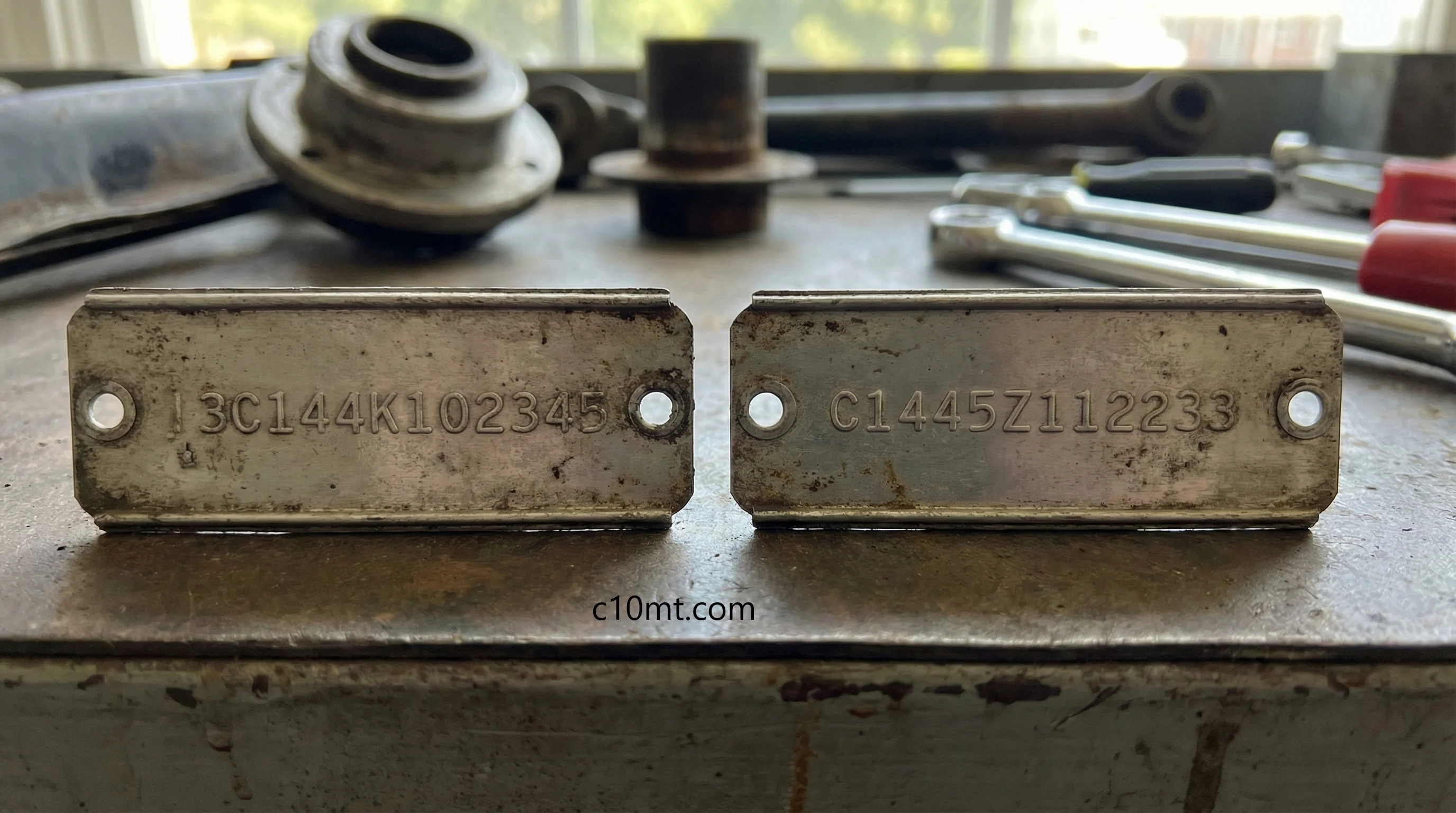
Forensic Application: Consider a VIN starting with 3C144....
- 3: The year 1963.
- C: A two-wheel-drive chassis.
- 14: A half-ton, short-bed configuration (115" wheelbase).
- 4: A traditional pickup body.
This sequence provides immediate "triangulation" value. If a seller presents a highly coveted "Short Bed" truck, but the VIN reveals a "15" (the code for a 127" long bed), the investigator has uncovered a "cut-down" frame. While a common modification in the restomod community, it fundamentally alters the vehicle's manufacturing DNA and market valuation.
2.2.2. The 1964–1966 Format: The Structural Inversion
For the 1964 model year, the first digit continued to be the year ('4'). However, for the 1965 and 1966 model years, the structure inverted, placing the chassis type first and the year later in the sequence. This inconsistency often catches restorers off guard.
1964 Format: 4 [Chassis][Plant] (Similar to previous years).
1965–1966 Format: [Chassis][Plant]
| Position | Meaning | Code Breakdown |
|---|---|---|
| 1st Digit | Chassis Type | C = 2WD, K = 4WD |
| 2nd & 3rd | Series | 14 = 1/2-ton Short Bed, 15 = 1/2-ton Long Bed |
| 4th Digit | Body Type | 4 = Pickup |
| 5th Digit | Model Year | 5 = 1965, 6 = 1966 |
| 6th Digit | Assembly Plant | Standard Plant Codes (A, B, F, J, K, N, P, S, Z, 1=Oshawa) |
| 7th+ | Serial Number | Sequential |
Critical Observation: The subtle movement of the year digit is a primary point of confusion. A VIN beginning with C1445... denotes a 1965 model (C=2WD, 14=Short, 4=Pickup, 5=1965). If a user misinterprets the first digit as the year, they might confuse a 1964 (which starts with '4') with a 'C' code, or misread the '5' in the fifth position as part of the serial number. This structural change is a primary authentication check for distinguishing 1964 transition models from established 1965 productions.
2.3. The Investigator's Field Decision Rule
When standing at the door of a 1960–1966 C10, follow this logical progression to move from observation to conclusion:
- If VIN syntax ≠ Era: (e.g., a "C" code first on a claimed 1962 model), then verify plate attachment and typography for signs of modern reproduction.
- If Attachment/Typography is inconsistent: (e.g., hex screws on a 1964 plate), then inspect hidden frame stamps (typically on the top of the driver-side rail) and engine casting numbers.
- If Multiple Mismatches exist: Consult archival build sheets or a professional forensic lab. Any discrepancy between the VIN plate and the frame stamp on a 1960–1966 model should be considered a major red flag regarding the vehicle's legal provenance.
While the VIN is definitive, visual cues often assist in rapid identification before a deep VIN analysis is conducted.
- 1960: Identifying features include large oval pods on the hood housing the parking lights and a grille with "CHEVROLET" in the center. Torsion bar front suspension was introduced.
- 1962: The hood design was lowered, eliminating the oval pods. Single headlights replaced the dual setup, and the grille lettering moved to the bottom.
- 1963: A critical mechanical year; the torsion bar suspension was replaced with coil springs, and alternators replaced generators. The grille was redesigned with round headlight housings.
- 1964: Introduced the "flat" windshield (replacing the wraparound "knee-knocker" style) and a new cab design that would persist through 1966.
Forensic Limitations & Legal Note: While the variances described are based on GM Heritage Center records and recognized industry standards, legitimate post-factory repairs can occasionally explain a missing VIN plate or a replacement cab. However, readers are cautioned that VIN tampering—including the removal or swapping of plates—is a criminal offense in many jurisdictions. Always corroborate physical evidence with secondary documentation such as a Title history or a protect-o-plate before finalizing an investment.
The Action Line (1967–1972) Chevrolet C10 is the apex of classic truck collecting. Its iconic trims, from the "CST" to the "Cheyenne," represent the dawn of the luxury pickup. However, because these trucks are the most frequently cloned and forged, the investigator must shift from general observation to high-stakes forensic analysis. In this era, the factory introduced standardized "anti-theft" markers that act as the definitive defense against fraud.
3. The Action Line Era: 1967–1972 C10 VIN Forensics
For the investigator, the Action Line represents a maturation of manufacturing controls. During this period, General Motors standardized the physical identity of the truck, implementing redundant security features that are exceptionally difficult for counterfeiters to replicate with total accuracy.
3.1. The Rosette Rivet and the Anatomy of Typography
By 1967, the VIN plate location was standardized on the driver's side door jamb, specifically the door latch pillar. While this makes the plate easy to find, it also makes it a primary target for "re-vinning." To authenticate a 1967–1972 truck, you must look beyond the numbers and examine the hardware and font mechanics.
The Rosette Rivet: A Controlled Fastener The primary guard against identity theft during this era was the Rosette Rivet. Unlike a standard round pop rivet, the Rosette features a unique, five- or six-petal flower-shaped head. Historically, possession of these rivets was rarely available to the public and tightly controlled in practice by federal authorities and GM manufacturing. They were designed specifically for factory installation and authorized state-sanctioned repairs.
Forensic Red Flag: If a 1972 Cheyenne has its VIN plate attached with standard round rivets, hex screws, or adhesive, the "chain of custody" for that vehicle's identity has been broken. While a plate might be removed for a high-end paint job during a legitimate restoration, its re-attachment with non-factory hardware creates a legal cloud. It serves as an immediate signal to stop the inspection and verify the "Confidential VIN" on the frame.
The Typography of the Die Stamp Factory die stamps in the 1960s and 70s possessed specific character traits that modern laser-cut or generic hand-stamped reproduction plates often miss. Two specific markers define the GM "Action Line" font:
- The Flat-Top 3: The number '3' should have a perfectly straight horizontal line at the top, not a curve.
- The Open 4: The number '4' is typically "open" at the back of the triangle apex.
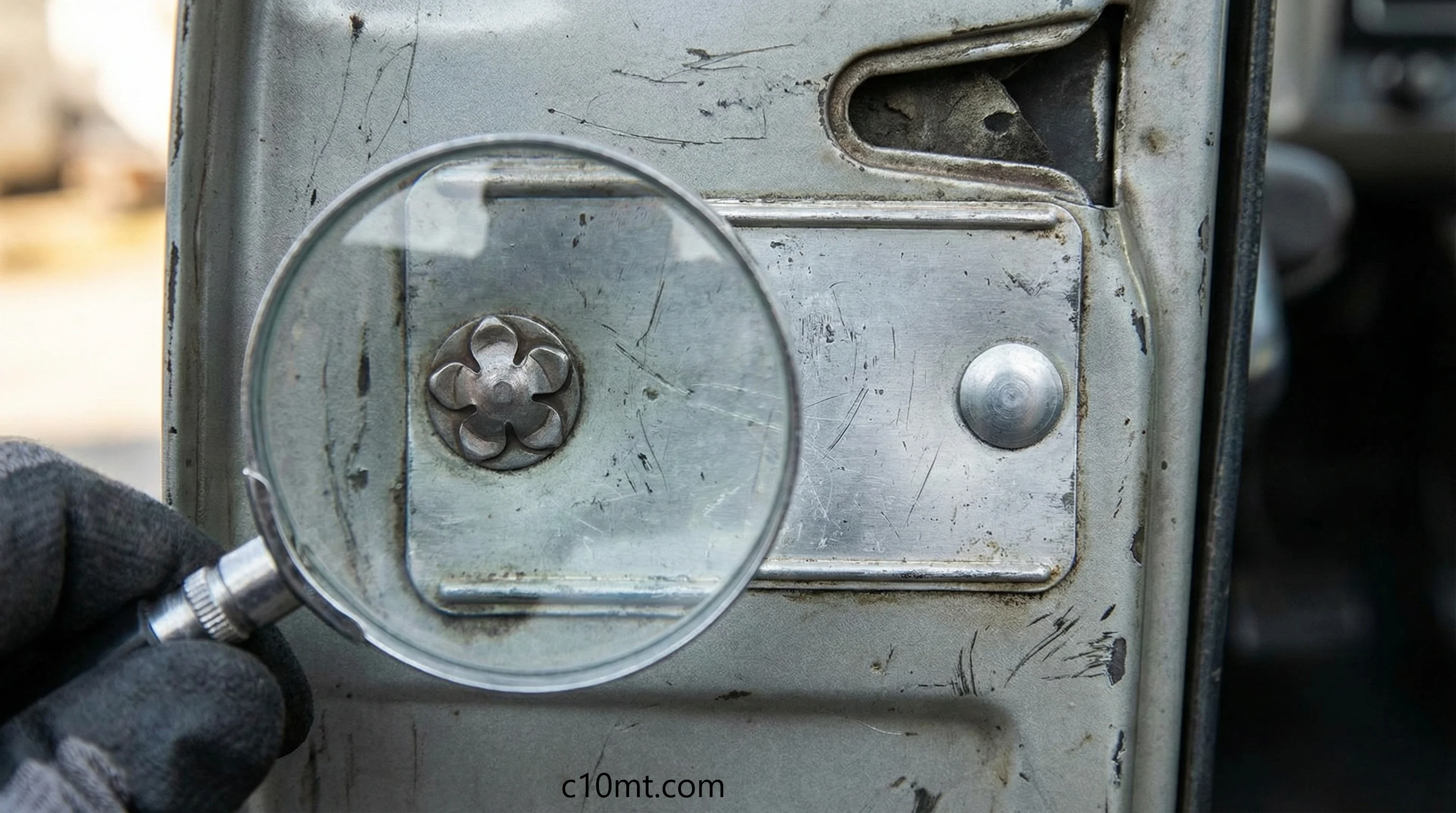
Discrepancies in stroke width, depth, or character spacing suggest a reproduction tag. When these subtle font errors are combined with non-Rosette rivets, the likelihood of a fraudulent identity increases to near certainty.
3.2. Decoding the Drivetrain DNA
The 1967–1972 VIN is an alphanumeric string that provides a clear map of the truck's weight rating and, most importantly, its original engine configuration. This is the "DNA test" for verifying if a truck was born as a V8 or an inline-6.
| Position | Meaning | Code Breakdown |
|---|---|---|
| 1st Digit | Chassis | C = 2WD, K = 4WD |
| 2nd Digit | Engine Type | E = V8, S = 6-Cylinder |
| 3rd Digit | GVW Range | 1 = 1/2 Ton (C10), 2 = 3/4 Ton (C20), 3 = 1 Ton (C30) |
| 4th Digit | Body Type | 4 = Pickup, 6 = Suburban, 8 = Blazer (Jimmy) |
| 5th Digit | Model Year | 7=1967, 8=1968, 9=1969, 0=1970, 1=1971, 2=1972 |
| 6th Digit | Assembly Plant | A=Atlanta, B=Baltimore, F=Flint, S=St. Louis, Z=Fremont, etc. |
| 7th-12th | Serial Number | Sequential (Start numbers vary by year; e.g., 1972 typically starts at 500001) |
Detailed Case Study: A VIN reading CE141Z100500.
- C: 2WD chassis.
- E: V8 Engine. (Crucial for verifying if a truck was "born" a V8 or swapped).
- 1: 1/2 Ton rating.
- 4: Pickup body style.
- 1: 1971 Model Year.
- Z: Built at the Fremont, CA Assembly Plant.
- 100500: The 500th truck built at Fremont that production year.
Insight on Engine Codes: The second digit of the VIN is the critical marker. As defined by GM Heritage records, an 'E' designates a V8 engine, while an 'S' denotes a 6-cylinder. This single letter has massive valuation implications. A truck currently housing a 396 Big Block but bearing an 'S' code VIN is, in forensic terms, an "engine-swapped restomod" rather than a "factory big-block survivor." While swaps are common, misrepresenting an 'S' code truck as a factory original is a common deception in the classic market.
3.3. The Confidential Frame VIN: The Final Word
If the door jamb plate is the "birth certificate," the Confidential VIN (CON VIN) stamped into the steel frame rail is the "DNA." Stamped directly into the chassis during assembly, this was GM's final failsafe against theft, often utilized by law enforcement and the National Automobile Theft Bureau (NATB).
Location and Visibility On Action Line models, this stamp is typically located on the top of the driver's side frame rail. Its specific placement is usually in the engine bay, near the steering box mounting location, or slightly further back under the cab floor. Because these areas are prone to decades of road grime, undercoating, and rust, recovery of the number often requires careful scraping and the use of a mechanic's mirror.
The Investigator's Decision Rule:
- If plate attachment or typography ≠ Era: Immediately inspect the frame CON VIN and engine casting numbers.
- If frame CON VIN is missing or illegible: Escalate the investigation to check for paint/fastener metallurgy and request archival build sheets.
- If multiple mismatches exist: Treat the vehicle as having compromised provenance. Advise a legal/DMV check before any purchase or sale.
Forensic Limitations & Legal Note: While these variances are based on GM archival data and recognized industry standards, legitimate restorations can create benign anomalies. However, VIN tampering—including the removal or swapping of plates—is a criminal matter. Always corroborate physical evidence with secondary documentation, such as archival build sheets or original Title records, before asserting fraud.
3.4. Investigator's Field Checklist Expanded
Purpose: Turn the Rosette rivet and die‑stamp inspection into a repeatable, defensible procedure. Use this checklist in the field to collect evidence, preserve context, and make a clear decision about authenticity.
3.4.1. Tools and consumables
- Magnification: 10–20× loupe; small jeweler's loupe for fine typography.
- Lighting: High‑lumen LED inspection light with adjustable beam and diffuser.
- Cleaning: Soft brass or stainless wire brush, plastic scraper, and gentle solvent (degreaser) for removing undercoating and grime.
- Access aids: Mechanic's mirror, flexible inspection camera (borescope) if available.
- Photography: Macro‑lens camera or phone macro attachment; tripod or phone clamp for steady closeups.
- Measuring: Small steel rule or calipers for rivet/head diameter and stamp stroke width.
- Marking and scale: Metric/imperial ruler or coin for scale in photos; non‑permanent masking tape and pencil for labeling.
- Safety and preservation: Nitrile gloves, eye protection, and a soft cloth to avoid introducing scratches.
- Optional lab tools: Portable magnet (to detect non‑ferrous plate), handheld XRF or metallurgical test kit if available for alloy checks.
3.4.2. Photo protocol and metadata
- Essential shots: Straight‑on VIN plate (full plate, centered); Close‑up of each rivet head (macro, both rivets if two); Plate edge and backer area (show welds, deformation); Frame stamp area (wide shot and macro of characters); Engine suffix pad and transmission stamp (macro).
- Context shots: Door jamb area, surrounding paint, and any repair seams or filler.
- Scale and orientation: Include a ruler or coin in every macro shot; photograph with consistent orientation (top of plate toward top of frame).
- File labeling: Immediately label images with date, location on vehicle, and shot number (e.g., 2026‑01‑07_DoorJamb_VIN_01).
- Metadata: Record GPS or location, inspector name, and ambient conditions in a short log entry.
3.4.3. Inspection checklist and measurements
- Rivet profile: Measure head diameter and note shape (rosette petal count). Photograph head from multiple angles.
- Attachment method: Note spot welds, rivet type, or mechanical fasteners; inspect for fresh weld marks, grinding, or filler.
- Plate edge condition: Look for bending, tool marks, or evidence of re‑seating; photograph plate back if accessible.
- Paint and overspray: Check rivet heads and plate edges for overspray or mismatched paint layers indicating removal/re‑installation.
- Typography metrics: Measure stroke width, character height, and spacing for at least three characters (include Flat‑Top 3 and Open 4 if present). Capture magnified images at consistent scale.
- Stamp depth and tooling marks: Note depth of impressions and any irregularities in stroke bottoms or side walls.
- Alignment and spacing: Check that characters sit on a straight baseline and that serial spacing is uniform.
- Corroborating parts: Record casting numbers, engine pad suffix, transmission stamp, and any factory option tags; photograph and transcribe.
3.4.4. Quick field tests
- Magnet test: Verify plate and rivet material (ferrous vs non‑ferrous) to detect aftermarket steel plates on aluminum or vice versa.
- Surface cleaning test: Gently remove a small area of grime to reveal original finish—stop if paint or substrate looks disturbed.
- Rivet edge inspection: Use loupe to check for tool marks around rivet shanks or evidence of re‑drilling.
3.4.5. Decision rules and escalation
- Green: Rosette rivets present; plate attachment consistent with era; typography matches authenticated examples; frame CON VIN matches plate → proceed to document and archive.
- Amber: One anomaly (e.g., minor rivet wear, slight typography variance) → perform deeper checks: casting numbers, engine suffix cross‑check, archival build sheet lookup.
- Red: Non‑Rosette rivets + typography mismatch + frame CON VIN absent or different → stop sale/transfer; recommend forensic lab analysis and DMV/legal check.
3.4.6. Documentation and chain of custody
- Transcribe every visible code immediately into a written log (VIN, CON VIN, engine suffix, casting numbers).
- Preserve original photos and raw files; do not edit or crop originals used as evidence.
- Record any cleaning or scraping performed, who performed it, and why.
- If legal action is possible, advise the owner/client to avoid further alterations and to consult local authorities or a certified appraiser.
3.4.7. Common pitfalls and caveats
- Legitimate restorations: Plates may be removed during restoration and reattached with non‑factory hardware—always seek restoration receipts or shop records.
- Plant variation: Rivet and plate practices could vary by plant and month; cross‑reference production month and plant codes before concluding fraud.
- Environmental wear: Corrosion and undercoating can obscure original features—use conservative cleaning and document pre‑cleaning condition.
Tools ready; photos taken with scale; rivet shape measured; plate edge checked; typography measured; frame CON VIN verified; log and label all evidence; escalate if two or more red flags. Use this expanded checklist as your standard operating procedure for 1967–1972 Action Line inspections. It converts visual expertise into reproducible evidence and gives you a defensible path from initial observation to final determination.
4. The Squarebody Era: 1973–1987 C10 VIN Forensics
The "Squarebody" era introduced a longer production run and, midway through, a massive federally mandated change in VIN standardization. This era is uniquely divided into two distinct VIN periods: the 13-digit era (1973–1980) and the 17-digit era (1981–1987).
4.1. The 13-Digit VIN System (1973–1980)
This system was an evolution of the previous era but added specific designators for the GM division, acknowledging the badge engineering shared between Chevrolet and GMC.
Format: [Chassis][Engine][Plant]
| Position | Meaning | Code Breakdown |
|---|---|---|
| 1st | Division | C = Chevrolet, T = GMC |
| 2nd | Chassis | C = 2WD, K = 4WD |
| 3rd | Engine Code | Specific Letter Codes (e.g., Y=350, U=454, Q=305) |
| 4th | Series | 1 = 1/2 Ton, 2 = 3/4 Ton, 3 = 1 Ton |
| 5th | Body Type | 4 = Pickup, 6 = Suburban, 8 = Utility (Blazer) |
| 6th | Year | 3=1973, 4=1974... 9=1979, A=1980 |
| 7th | Plant | Z=Fremont, S=St. Louis, F=Flint, etc. |
| 8th+ | Serial | Sequential Production Number |
Note on 1980: The year code for 1980 is 'A', not '0'. This change was made to avoid confusion with the 1970 model year (which used '0') and acts as a bridge to the 1981 standardization. Seeing a '0' in the year position of a Squarebody style truck immediately identifies it as a 1973-1979 era VIN or a potential anomaly.
4.2. The 17-Digit NHTSA Standard (1981–1987)
In 1981, the National Highway Traffic Safety Administration (NHTSA) mandated a standardized 17-character VIN for all road vehicles sold in the United States. This system introduced the World Manufacturer Identifier (WMI) and the mathematical "Check Digit", making VIN forgery significantly more difficult for the casual criminal.
Format: [Line/Chassis][Engine][Check][Plant]
| Position | Meaning | Code Breakdown |
|---|---|---|
| 1-3 (WMI) | Manufacturer | 1GC = Chevrolet Truck (USA), 1GT = GMC Truck (USA) |
| 4 | GVW/Brake System | C=4001-5000lbs, E=6001-7000lbs, etc. (Hydraulic brakes implied) |
| 5 | Chassis Type | C = 2WD (1981-86), K = 4WD (1981-86), R = 2WD (1987), V = 4WD (1987) |
| 6 | Series | 1 = 1/2 Ton, 2 = 3/4 Ton |
| 7 | Body Type | 4 = 2-door Cab, 6 = Suburban, 8 = Blazer/Jimmy |
| 8 | Engine Type | Letter Code (e.g., H=305, L=350, N=454 Diesel) |
| 9 | Check Digit | A calculated number (0-9 or X) derived from an algorithm to verify VIN validity |
| 10 | Model Year | B=1981, C=1982, D=1983, E=1984, F=1985, G=1986, H=1987 |
| 11 | Plant | Plant Code (F=Flint, Z=Fremont, etc.) |
| 12-17 | Serial | Sequential Number |
The 1987 Nomenclature Shift: A critical detail for identifying late-model Squarebodies is the chassis designation change in 1987. GM was preparing to introduce the new body style (GMT400) in 1988, which would take the "C/K" designation. To avoid manufacturing and ordering confusion, the remaining Squarebody trucks produced in 1987 (and Suburbans/Blazers/Crew Cabs through 1991) were re-designated as "R" (2WD) and "V" (4WD) in the VIN (Position 5). Thus, a 1987 Squarebody is technically an R10 or V10, not a C10 or K10, despite common parlance. A VIN claiming to be a 1987 model but containing a 'C' or 'K' in the fifth position is suspect.
4.3. Squarebody Frame VIN Location
A major forensic shift occurred in the Squarebody era regarding the confidential frame stamps. Unlike the 1967–1972 models where the stamp was on the driver's side, the Squarebody (1973–1987) confidential VIN is typically found on the passenger side frame rail.
- Location: Top of the frame rail, passenger side.
- Reference Point: It is often located near the engine mount or under the cab floor beneath the passenger seat/door area.
- Recovery: Like earlier models, this area is highly prone to rust and is often covered in thick undercoating. The use of a mirror and careful scraping with a wire brush is required to reveal the numbers. Finding this stamp is the definitive way to prove a truck has not been "cab swapped"—a common practice where a rusty cab is replaced with a clean one from a different truck, creating a "Frankenstein" vehicle with conflicting identities.
5. Engine Forensics: The "Numbers Matching" Verification
While the VIN identifies the chassis and the body's intent, the engine suffix code identifies the power plant. For a truck to be truly "numbers matching," the engine block must bear a stamp that specifically correlates to the VIN of the truck.
5.1. The Engine Stamp Pad
On classic Small Block (SBC) and Big Block (BBC) Chevy engines, the identification data is stamped on a machined pad extending forward from the block deck surface, on the passenger side, typically behind the alternator location. This "pad" is a small, flat surface that was machined (broached) at the factory.
The stamp typically consists of two distinct parts:
- Assembly Date/Plant Code: e.g., V0101
- V: Plant Code (V = Flint Engine Plant, T = Tonawanda, etc.)
- 01: Month (January)
- 01: Day (1st Day)
- Suffix Code: A 2- or 3-letter code indicating the engine's displacement, horsepower rating, transmission pairing, and vehicle application (e.g., TY, TBA).
5.2. Decoding the Suffix
The suffix code is the key to determining if an engine is correct for a truck or if it was sourced from a passenger car (Impala, Chevelle, Camaro).
- Truck vs. Car Codes: Before 1970, suffix codes were often 2 letters. Starting in 1970, they expanded to 3 letters. The third letter (or the prefix in some lists) often helped distinguish car from truck applications. For example, in the 1970-1972 era, the code letter 'T' often appeared in truck codes (e.g., TA, TE, TBA).
- The "Lime Book" Data: Suffix codes are year-specific. A code like TY might mean a 327 in 1968 but a 350 in 1971.
- Example 1969 Codes: PA (292 L6), TE (350 V8), TD (307 V8).
- Example 1972 Codes: TJK (350 V8), TPZ (402 V8 - often marketed as 400 or 396).
- Example 1980s: Later codes became even more specific, often utilizing codes like UTD for specific emissions requirements.
5.3. The Partial VIN on Engine
Starting in the late 1960s (and mandated federally later), a "Partial VIN" was also stamped on the engine pad next to the assembly/suffix code. This partial VIN contains the model year, assembly plant, and the matching serial number of the truck.
- Verification Logic: Check the Dashboard/Door VIN: Ends in 123456; Check the Engine Pad: Does it include the sequence ...123456?
- Born-With vs. Period Correct: If the serial matches (123456), it is the original engine installed at the factory ("Born-With"); If the suffix code is correct for the year and model (e.g., a Truck 350 code) but the serial number doesn't match, it is a period-correct replacement (often acceptable in restoration but less valuable); If the suffix code belongs to a 1974 Impala (e.g., C prefix codes), it is a non-original swap and affects the vehicle's pedigree.
5.4. Broach Marks and Decking
A critical aspect of engine forensics is the presence of "broach marks." The factory machining process left faint, parallel lines running the length of the stamp pad.
- Decking: When an engine is rebuilt, machine shops often "deck" the block to flatten the mating surface for the cylinder head. This process usually machines away the original broach marks and the stamped codes.
- Restamping: Unscrupulous sellers may restamp a decked block to match a car's VIN. However, identifying a fake stamp often involves looking for the absence of broach marks (a smooth, polished pad suggests decking) or broach marks that run in a different direction than factory specifications. A stamp on a perfectly smooth pad is highly suspicious.
6. The Service Parts Identification (SPID) Label
Perhaps the most valuable single document for a C10 restorer is the Service Parts Identification (SPID) label. This is essentially the "Build Sheet" of the truck, listing every Regular Production Option (RPO) installed at the factory.
6.1. Evolution and Location
- 1967–1972: The SPID label was typically affixed to the inside of the glovebox door. It was a paper or foil-backed sticker containing a typed list of RPO codes (e.g., L47, M49) and their text descriptions.
Fragility: These labels are extremely fragile. On many surviving trucks, they are peeled, faded, or missing entirely due to moisture or cleaning. Reproductions exist, so forensic examination of the paper aging, glue patterns, and type style is necessary to confirm authenticity. - 1973–1987: The location generally remained on the inner glovebox door for the Squarebody generation, though it occasionally moved to the inner fender or hood in later years or specific models.
- Modern Era: In 2018, GM moved away from SPID labels to QR codes on the B-pillar, marking the end of the traditional RPO sticker era.
6.2. Reading RPO Codes
The RPO code is a 3-character alphanumeric code that acts as a shorthand for specific options.
- Z71: Off-Road Suspension (which later became a model name in itself).
- YE9: Silverado Trim Level (top of the line luxury trim).
- LS9: 350 V8 Engine.
- N40: Power Steering.
- C60: Air Conditioning.
Forensic Utility: The SPID label is the ultimate truth-teller against "up-badging." If a truck is presented as an original "Big Block Silverado," the SPID label must contain the RPO code for the big block engine (e.g., L47, LS4) and the Silverado trim (YE9). If the label lists a 6-cylinder code (LD4) or a lower trim level (Z62 Custom Deluxe), the truck is a clone or a "tribute" vehicle. Verifying the VIN against the SPID (often the VIN is printed on the SPID) links the options to that specific chassis.
7. Advanced Forensic Details: Rivets, Fonts, and Counterfeits
For the high-end collector, the difference between a $20,000 truck and a $80,000 truck often lies in the microscopic details of its tags.
7.1. Rosette Rivets
As previously noted, the rosette rivet is a controlled fastener. Its head is not smooth like a standard pop rivet; it has a flower-like pattern. Possession of these rivets was restricted to factory settings to prevent VIN swapping.
Detection: Factory rosettes have a specific patina. New, shiny rosettes on a weathered VIN plate suggest a recent restoration or VIN swap. The petals should be distinct. If a VIN plate is held on by round rivets (on a post-1966 truck) or screws, the vehicle's identity is suspect.
7.2. Typography (Fonts)
Factory stamping dies had unique characteristics that are difficult to replicate with generic stamp sets.
- Flat Top 3: The number '3' in GM stamps typically has a flat top bar, not a rounded one.
- Open 4: The number '4' is often "open" at the top back, rather than a closed triangle.
- Alignment: Factory stamps were often hand-aligned or machine-gang stamped. They are usually relatively straight but may show varied depth. Perfectly laser-aligned stamps on a 1965 plate might indicate a modern reproduction tag.
8. Conclusion: The Methodology of Verification
To verify the manufacturing DNA of a Chevy C10, one must adopt a holistic, multi-point approach. The VIN plate is the starting point, but it is the correlation of data that proves authenticity.
The Verification Checklist:
- Decode the VIN: Does the chassis code match the drivetrain layout? Does the year code match the body styling?
- Verify the Plate: Is the location correct for the year (e.g., B-pillar for 1962, Latch Pillar for 1970)? Are the rivets correct (Rosette for 1967+)?
- Find the Confidential VIN: Locate the frame stamp (Driver side for 1967-72, Passenger side for 1973-87). Does it match the plate?
- Check the SPID: Does the glovebox sticker list the options currently on the truck? Is the paper age-appropriate?
- Examine the Engine: Decode the suffix and partial VIN. Is it a truck engine? Is it the original engine?
By rigorously applying these forensic steps, the enthusiast ensures that the history of the Chevrolet C10 is preserved, distinguishing the genuine artifacts of American automotive history from the replicas.
| Year Range | Primary VIN Plate Location | Attachment Method | Frame VIN Location |
|---|---|---|---|
| 1960–1963 | Driver Door Jamb / B-Pillar Face | Spot Weld / Round Rivet | Top of Rail (Var) |
| 1964–1966 | Driver Step Well / Header / Pillar | Spot Weld / Round Rivet | Top of Rail (Driver) |
| 1967–1972 | Driver Door Jamb (Latch Pillar) | Rosette Rivet | Top Rail (Driver Side, Steering Box area) |
| 1973–1980 | Driver Door Jamb | Rosette Rivet | Top Rail (Passenger Side) |
| 1981–1987 | Dashboard (Driver Side - Windshield) | Rosette Rivet | Top Rail (Passenger Side) |
| Code | Plant Location | Notes |
|---|---|---|
| A | Atlanta, GA | Common in South/East |
| B | Baltimore, MD | ... |
| F | Flint, MI | The "Heart" of Chevy production |
| J | Janesville, WI | ... |
| S | St. Louis, MO | Major truck plant |
| Z | Fremont, CA | Common for West Coast trucks |
| 1 | Oshawa, Ontario | Canadian production |
| T | Tarrytown, NY | ... |
Technical Inspection & Safety Notice: This guide serves as a forensic framework for manufacturing identification and investment authentication only. It is not a substitute for a professional mechanical or safety evaluation. Given the age of these vehicles, all safety-critical systems—including chassis structural integrity, steering kinematics, fuel system sealing, and hydraulic brake performance—must be inspected and cleared by a certified technician before the vehicle is operated on public roads. Compliance with modern emissions and safety standards remains the sole responsibility of the owner.
- rosette rivets - Vintage Car Law
- How to Read Chevrolet VIN Numbers: Decode Your Chevy's History
- VIN-to-Year Chart - ALLDATA
- How to Spot Fake Corvette Vin Numbers
- How To Find the Vin on A Chevy Truck: A Quick Guide | #1 Cochran Chevrolet Youngstown
- 1964 - 1966 Chevrolet C-10 VIN Numbers - Classic Parts Talk
- 1965 VIN tag rivets - Corvair Center Forum
- GM & Chevy Truck VIN Decoder Chart | JEGS
- 1960-64 Chevrolet Serial Identification Number - LMC Truck
- Jim's Blog: Check Those Rivets - Sports Car Market
- Red Tape and Rosette Rivets - Linkage Mag
- HOW TO: Decode a VIN (Vehicle Identification Number) - Trusted Auto Professionals
- How to Decode a 1967–1972 Chevy C10/K10 VIN Number - Rust Belt OffRoad
- 1967-1972 Chevrolet VIN Number Codes - GMCPaul's Truck Parts
- 1967-72 Chevrolet Truck Chassis Identification
- '67 C-10 VIN, or Ser. Number? | Classic Parts Talk
- 1973-1980 Chevy Truck Vin Decoder Chevrolet and GMC - USA1 Industries
- CHASSIS IDENTIFICATION / ABBREVIATIONS - 1973-80 Vehicle ID Number (VIN) - LMC Truck
- Chevrolet and GMC 1981-1987 Chevy Truck Vin Decoder - USA1 Industries
- 81 C10 VIN Location : r/chevyc10 - Reddit
- TRANSMISSION / ENGINE IDENTIFICATION - LMC Truck
- Engine Codes - Drivin' It Home
- partial vin and engine numbers - Chevrolet & GMC - General - AACA Forums
- Small Block Chevy Identification Guide | Ground Up Motors - SS396.com
- Chevy Truck SPID Labels - Classic Chevy Trucks
- 1973-1983 GM Pickup Products - Impact Printed Reproduction SPID and Window Stickers
- 1967-1972 GM Pickup Products - Impact Printed Reproduction SPID, Window Stickers, and Protect-O-Plate Labels
- RPO Codes VIN Decoder - GM Chevrolet Buick Cadillac - Regular Production Option
- Chevy/GM RPO Codes from 1967-1986 - CJ Pony Parts
- RPO Codes And How To Read Them | Ground Up Motors - SS396.com
- VIN Plate Rivets | Canadian Corvette Forums